

Productivity Tips
Time Theft at Work: What It Is, What It Costs, and How to Prevent It in 2026
Time theft costs US employers an estimated $450 to $550 billion a year. Here are the 7 types, why it happens, and how to prevent it without…
Worktivity Team11 min read
If you searched "how to improve team productivity," the top ten results gave you a numbered list of things your team should start doing.
Salesforce's list. Slack's list. Zendesk's twenty-one ways. FranklinCovey's leader's guide. Training Magazine's ultimate guide. They all say roughly the same thing: meet more strategically, prioritize better, collaborate more efficiently, set clearer goals, recognize harder.
Most of those tips are not wrong. They are also asking your team to do more, do it differently, or do it better. The cumulative effect, when an operations leader actually rolls them out, is that the team's workload goes up. The result is the predictable opposite of the intended outcome: people burn out faster, output gets worse, and the engagement scores drop.
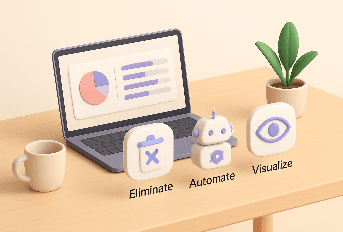
There is a different way to think about team productivity, and it is the opposite of "do more." The three-pillar framework below is built on three actions that reduce what the team is doing, automate what should not be human work, and visualize the data so the team can self-correct.
None of the three asks anyone to work harder. The output increase is the byproduct of stopping the things that were producing waste.
The operations leader gets pulled into a quarterly review. The numbers are softer than expected. The pressure increases. The instinct is to "boost productivity."
The next step is usually a town hall, a new prioritization framework, a more structured weekly cadence, and a recommitment to hitting the targets. The team hears: we need to do more.
For about three weeks, the team does do more. Hours go up. Output rises modestly. Engagement begins to soften. By week six, output is flat again and the team is more tired. By week twelve, regrettable turnover is climbing and the operations leader is in another quarterly review with even softer numbers.
The trap is that the boost approach treats productivity as an input problem (how hard people work) when it is almost always a system problem (how the work is structured).
The data on this is consistent across industries. Output per hour, in knowledge work, is bounded by structural factors: how much focus time the team gets, how much waste sits in the workflow, how clearly the team sees the patterns in their own work. None of those structural factors are improved by asking people to work harder.
The framework below changes the structural factors instead. The output gains follow without anyone working longer hours.
Three reasons explain why the standard productivity-boost playbook produces poor results.
Reason 1: The team is already at or above sustainable capacity.
Most operations teams in 2026 are running above 90% of theoretical capacity. The team that the operations leader is trying to "boost" has no slack left. Asking them to do more produces immediate burnout signals: longer hours, more sick days, more friction in handoffs, more quality issues, more turnover.
Reason 2: Doing more amplifies waste.
If the workflow contains waste (unnecessary meetings, redundant approvals, low-value tasks the system requires), asking the team to do more amplifies the waste alongside the productive work. The team produces more meetings, more approvals, more low-value output. Real productive output rarely increases proportionally.
Reason 3: The signal-to-noise ratio gets worse.
When everyone is doing more, the data the operations leader uses to make decisions gets noisier. More activity, more reports, more meeting notes, more updates. The actual operating signals (what is shipping, what is stuck, where the margin is leaking) get harder to extract from the noise.
The framework below avoids all three traps by reducing rather than expanding.
The fastest way to improve team productivity is to stop doing things the team should not be doing. This is the highest-leverage pillar and the most resisted.
The questions to ask, by category:
Meetings that should not exist.
For most operations teams, applying these questions to the existing meeting calendar eliminates 20-40% of weekly meeting load. The recovered time goes directly into productive output without anyone working extra hours.
Reports nobody reads.
Approval chains that no longer make sense.
Status updates that nobody reads carefully.
Elimination produces no resistance from the people doing the work. They were never enthusiastic about the meeting, the report, or the approval chain. The resistance comes from the people who set up these structures and feel ownership of them. The operations leader has to hold the line.
The second pillar is moving work the team does manually into systems that handle it automatically.
The targets, in priority order:
Time and timesheet entry.
Status reporting.
Notification triage.
Routine data entry and updates.
Automation does not eliminate jobs. It eliminates low-value tasks within jobs. The contributor whose timesheet now logs itself spends the recovered time on higher-value work, not on more low-value work.
The third pillar is the most counter-intuitive and the highest-leverage of the three over time.
When the team can see their own contribution and workflow data clearly, they self-correct without management intervention. The operations leader does not have to tell the team that workload is uneven or that one project is consuming more time than it should. The team sees it in their own dashboard and brings it to the operations leader.
The data layers that matter:
Contributor-facing utilization and billable mix.
Team-level capacity distribution.
Project-level margin and cycle time.
Cross-team dependency tracking.
Visualization changes the dynamic. The operations leader stops being the only person who sees the system. The team becomes part of the operating system. Decisions get made faster, by the people closest to the work, with the data in front of them.
A 50-person digital agency adopted the eliminate-automate-visualize framework in Q1 2026.
Eliminate (Weeks 1-3):
Automate (Weeks 4-7):
Visualize (Weeks 8-12):
Outcome at end of Q1:
No one was asked to work harder. The output improved because the system around the work improved.
The framework above takes a quarter to fully implement. The experiment that proves the framework to your team takes three weeks.
Week 1: Eliminate one meeting per contributor.
Ask every team member to identify one recurring meeting on their calendar that they would not miss if it disappeared. Eliminate or convert to async those meetings. Recover roughly 60 minutes per person per week.
Week 2: Automate one routine task per role.
Identify one routine task per role that should not be human work. Move it into automation (time tracking, status update generation, notification routing, calendar management). Recover roughly 30 minutes per person per week.
Week 3: Open one contributor-facing dashboard.
Turn on a contributor-facing data view that the team did not previously have. Most operations teams have some version of this available in tools they already own; the data is just not exposed to the contributor. Open it. Watch what happens.
At the end of three weeks, recovered productive time per contributor will be approximately 90 minutes per week. Team engagement signals will be measurably better. No one will have been asked to work harder.
That is the proof. From there, the full framework rollout is straightforward.
What is the 3-3-3 rule for productivity?
The 3-3-3 rule (3 hours deep work, 3 short tasks, 3 maintenance items per day) is one of many time-blocking heuristics. It works for individual productivity. It does not address team-level productivity, which is about workflow structure rather than individual scheduling. The eliminate-automate-visualize framework above addresses the team-level problem.
What are the 5 P's of productivity?
The 5 P's framework (Plan, Prioritize, Protect, Perform, Pause) is a common individual productivity framework. Again, useful for individuals, less useful for teams. Team productivity is about removing structural waste, not about helping individuals plan better.
What are the 5 C's of team effectiveness?
The 5 C's (Communication, Coordination, Cooperation, Commitment, Constructive conflict) are cultural attributes of effective teams. Worth attending to. But cultural attributes are improved by the system around the team, not by exhortation. The framework above improves the system. The cultural attributes improve as a result.
What are the 4 P's of productivity?
The 4 P's framework (Plan, Prioritize, Pinpoint, Perform) is another individual productivity model. As with the others, it does not address the team-level structural questions that produce the largest productivity gains in operations.
How long does it take to see results from this framework?
The 3-week experiment described above produces measurable results in three weeks. The full framework rollout (eliminate, then automate, then visualize) takes a quarter. The 50-person agency case study showed 8 percentage points of billable utilization improvement in one quarter.
Most productivity advice tells the team to do more. The framework above improves productivity by eliminating waste, automating routine work, and giving the team visibility into its own data.
The output gains follow. Nobody works harder. The team gets healthier. The operations leader stops fighting the same productivity fight every quarter.
If your team needs the visibility layer (Pillar 3) and you do not have it built yet, start a 14-day Worktivity free trial. Worktivity is the contributor-facing visibility tool that makes the visualization pillar actually work.
If your team needs help on the eliminate or automate pillars first, you do not need a tool. You need to start the audit Monday morning.
More from the same corner of the blog.
Time theft costs US employers an estimated $450 to $550 billion a year. Here are the 7 types, why it happens, and how to prevent it without…
Buddy punching costs US employers an estimated $373M a year. Here's what it is, why time clocks miss it, and how to prevent time theft without…

Most remote team management guides give you tips. This is the operations playbook: hiring, onboarding, daily ops, performance, and scaling, chapter…
Worktivity turns the activity your team already generates into a picture you can act on: automatic time tracking, productivity scores and payout-ready reports.
Free 14-day trial. No credit card required.