

Employee productivity software that measures what matters
Work pattern analysis rather than surveillance, with focus time, capacity and progress in one view.
Worktivity brings automatic time tracking, activity analytics, AI coaching and workload balancing into a single platform, so managers can see capacity and focus without asking anyone for a status update.
14-day free trial · No credit card required
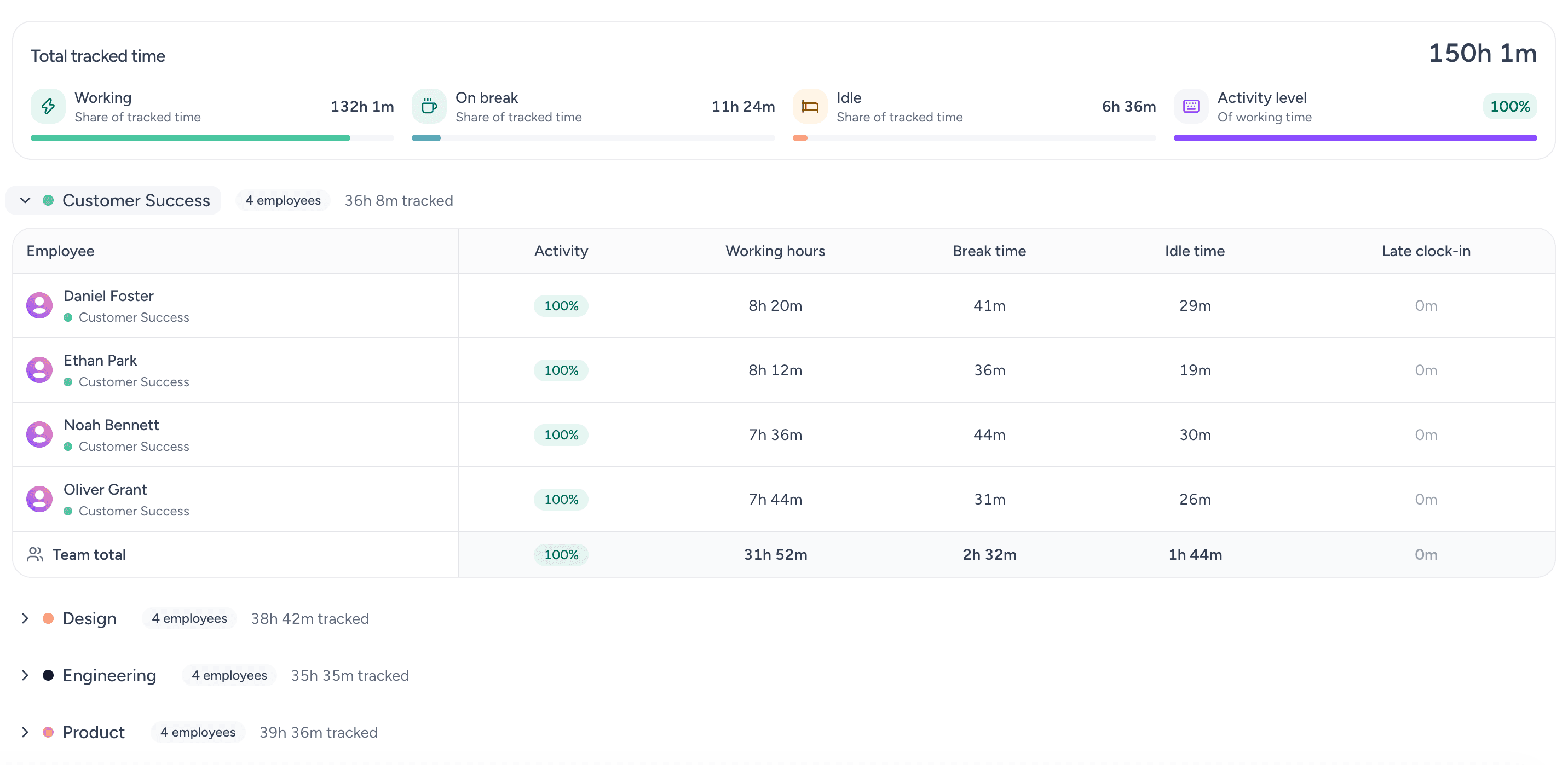
What the platform covers
Eight capabilities that together replace the usual patchwork of timesheets, spreadsheets and status meetings.
Live productivity visibility
Live visibility into how the day is going, per person and per team, without a single check-in message.
AI-powered productivity analytics
Models identify the patterns behind good and bad weeks and produce specific recommendations rather than a chart to interpret.
Time tracking without timesheets
Hours, breaks and project time recorded in the background. Nobody fills in a timesheet, and the record is more accurate for it.
Productivity dashboards and exports
Trend views, individual performance, team comparisons and exports, refreshed continuously rather than assembled monthly.
App and website monitoring
Time by tool, classified per role. This is where wasted license spend and genuine distraction both become visible.
Productivity coaching
Per-employee guidance drawn from that person's own patterns: when their focus peaks, where their day fragments, what to change first.
Team benchmarking
Comparison against internal baselines and similar teams, so a number has a reference point instead of floating free.
Workload balancing
Overload and underuse shown side by side, which is the prerequisite for redistributing work before someone burns out.
Why teams adopt it
Five reasons that come up repeatedly in customer reviews.
Up to 25% more output
Most of the gain comes from removing fragmentation and rebalancing load, not from pushing people harder.
Management by data
Resource decisions, hiring cases and process changes become arguable from a shared record rather than from competing impressions.
Lower operating cost
Idle licenses, duplicated effort and hours lost to context switching are all measurable, and therefore all reducible.
Analytics that go deep enough
Peak hours, focus duration, tool concentration and consistency are the second-order metrics that explain the first-order ones.
Employees who can see themselves
Self-visibility changes behavior more reliably than manager visibility does, and it is the reason productivity tooling survives past the first quarter.
Measurement, not monitoring theater
Four principles behind how Worktivity treats productivity data.
Patterns over snapshots
A bad Tuesday is noise. Worktivity reports on direction and consistency, because those are the only things worth acting on.
Allocation before evaluation
The first use of productivity data should be reallocating work rather than ranking people. Rankings are available; they are simply not the point.
Transparency as a feature
Every employee can see their own data. A productivity platform that hides its output from the people it measures does not survive contact with them.
Strategy-grade reporting
Executive dashboards roll the same underlying data up to the level where headcount and tooling decisions get made, without a separate reporting project.
Reported results
Aggregate figures from Worktivity customers running the platform for at least two quarters.
25% productivity increase
Driven by workflow changes the data made obvious, most commonly meeting-load reduction and workload redistribution.
20% cost reduction
From license rationalization, fewer duplicated handoffs and better matching of capacity to demand.
Higher employee satisfaction
Fair workload distribution and visible metrics correlate with better engagement scores, which is the opposite of the usual assumption about monitoring.
Industries using employee productivity software
The strongest fits are organizations where payouts is the dominant cost and output is digital.
Technology & software development
Estimation improves once you can see where sprint time actually goes, and deep-work fragmentation is usually the first thing the data exposes.
Marketing & advertising agencies
Campaign time by client and by phase is the basis for both accurate billing and honest scoping of the next brief.
Consulting & professional services
Billable versus non-billable time captured automatically, and utilization that reflects reality rather than what got typed in on Friday.
Healthcare & medical services
Administrative load is the usual hidden cost in clinical operations. Measuring it is the first step to reducing it.
Financial services & banking
Process-heavy work benefits most from friction analysis, and the audit trail is useful for compliance in its own right.
Legal services & law firms
Billable-hour capture without manual entry, plus a defensible record of what the time was actually spent on.
Related Worktivity guides
Neighboring topics, in case you arrived here from a slightly different question.
Hybrid Workforce Management
One platform and one standard for in-office and remote employees alike.
Learn moreProductivity Monitoring Software
Trend, peak-hour and benchmark analysis for whole teams.
Learn moreRemote Employee Monitoring
Visibility across distributed teams, with privacy settings that make it survivable.
Learn more
Employee productivity software questions
The questions that come up most often during evaluation.
What is employee productivity software?
A platform that measures how work time is used, analyzes the patterns and recommends changes. It combines time tracking, activity analytics and workload management in one place.
How does employee productivity software work?
A desktop agent records activity, application usage and working hours. Worktivity classifies that data, computes productivity metrics and presents dashboards, trends and recommendations to employees and managers.
Is it surveillance?
It is designed not to be. Worktivity measures patterns rather than content, employees see their own data, and the intended use is capacity and process management rather than individual policing.
Is employee productivity software legal and ethical?
Legal in most jurisdictions when employees are informed and the data collected is proportionate to a legitimate purpose. Ethical use comes down to what you do with the output: process improvement rather than punishment.
How much does it cost?
$3.99 per user per month, with a 14-day free trial and no card required. Enterprise plans add advanced controls and dedicated support.
Does it integrate with other tools?
Yes. Worktivity connects with common project management and accounting tools, including Asana, Trello and Zapier, so time data reaches the systems that already run your workflow.
How secure is the data?
Encryption in transit and at rest, role-scoped dashboard access, configurable retention and GDPR-aligned operation. Productivity data is treated as employee data, which is the standard it has to meet.
Which industries benefit most?
Technology, agencies, consulting, legal, healthcare administration and financial services. In short, anywhere knowledge work dominates and payouts is the largest cost.
Start measuring what your team's time actually produces
Fourteen days, no card, and a full picture of focus, capacity and workload by the end of the first week.
14-day free trial · No credit card required