

News & trends
Ask AI and MCP: your Worktivity data, in plain language
Worktivity now answers questions about your team, projects and time in plain language, and connects to ChatGPT, Claude and any MCP tool.
Worktivity Team17 min read

Outsourcing means working with an external company or contractor instead of doing everything in-house.
In 2026, outsourcing is much broader than the old call-centre stereotype.
Today, companies outsource software development, marketing operations, finance and accounting, design, customer support, content production, and increasingly AI-supported operational work.
The benefits are real.
But the hidden costs are real too.
Most outsourcing content focuses only on the upside: lower cost, faster delivery, access to talent. Those points matter, but they are only half of the story.
This guide covers both sides.
First, we will look at 12 practical benefits of outsourcing.
Then we will cover the part many vendors do not put in the pitch deck: the hidden costs, the visibility gap, and how managers can keep outsourced teams accountable without creating a surveillance culture.
At its simplest, outsourcing means buying a service instead of building the capability internally.
The work may happen at another company, in another country, or even in another time zone. Instead of paying for internal headcount, you pay for a service, a team, or a defined output.
Common outsourcing categories in 2026 include:
Business process outsourcing, such as customer support, contact centres, back-office operations, accounts payable, and accounts receivable.
Knowledge process outsourcing, such as research, analytics, legal work, and financial modelling.
IT outsourcing, such as software development, infrastructure management, DevOps, and QA.
Marketing outsourcing, such as agency work, content production, paid media management, and SEO.
Creative outsourcing, such as design, video production, illustration, and copywriting.
AI-augmented outsourcing, where human teams and AI workflows work together and are priced as a service.
No matter the category, the buyer questions are usually the same.
Does this give us a capability we do not have?
Does it free up our internal team for higher-value work?
Can we trust the output?
Can it scale?
And most importantly, can we manage it without losing visibility?
Before looking at the benefits, it helps to understand the type of outsourcing arrangement you are entering.
Different models create different advantages and risks.
Offshore outsourcing means the work is done in a different country, usually in a lower-cost region.
Common examples include the Philippines, India, Eastern Europe, and Latin America.
The main benefit is cost reduction.
The main risk is coordination. Time zone differences, cultural gaps, language nuance, and longer feedback loops can all create friction.
Offshore outsourcing can work very well for high-volume or well-defined work. It is harder when the work needs constant real-time collaboration.
Nearshore outsourcing means the work is done in a nearby country with a similar or manageable time zone.
For example, US companies may work with teams in Latin America. Western European companies may work with teams in Eastern Europe. UK companies may work with teams in Ireland or Portugal.
The main benefit is cost reduction with less time zone friction.
The main risk is that the talent pool may be smaller than in offshore markets. Competition for strong vendors can also be higher.
Nearshore outsourcing is often a strong choice when collaboration speed matters.
Onshore outsourcing means the work is done in the same country, but by an external company.
The main benefit is simplicity.
There is usually stronger cultural alignment, fewer language issues, easier legal coordination, and more possibility for in-person meetings.
The main risk is cost.
Onshore outsourcing usually has the smallest cost advantage compared with hiring internally.
It works best when regulatory simplicity, brand understanding, or close collaboration matters more than maximum cost savings.
Hybrid outsourcing combines internal and external teams.
This is increasingly common in engineering, marketing, customer support, and operations.
For example, a company may keep strategy and core product knowledge in-house, while outsourcing execution, surge capacity, QA, or after-hours support.
The main benefit is flexibility.
You can scale up or down without going through hiring and firing cycles.
The main risk is coordination overhead.
When internal and external teams work together, ownership has to be very clear. Otherwise, work gets duplicated, delayed, or lost between teams.
Outsourcing can create real business value when it is used for the right work and managed properly.
Here are the most common benefits, in roughly the order they tend to matter in practice.
Cost reduction is the most obvious benefit of outsourcing.
It is also the one most often overstated.
A well-run outsourcing arrangement can create meaningful savings compared with equivalent in-house headcount, especially in high-cost regions.
In many cases, fully loaded savings may land somewhere around 30–60%.
But the final number depends on the full cost, not just the vendor invoice.
Management time, quality control, coordination, onboarding, tools, and rework all reduce the headline saving.
Outsourcing can be cheaper than hiring.
But it is rarely as cheap as the pitch deck suggests.
This is increasingly one of the strongest reasons to outsource.
Some skills are hard to hire locally at the right price or speed.
This is especially true for specific software stacks, AI and machine learning expertise, DevOps, multilingual support, specialised marketing operations, finance processes, and design production.
Outsourcing gives companies access to talent pools they could not reach through local hiring alone.
In some cases, the value is not just cost.
It is availability.
Hiring takes time.
A specialist outsourcing partner can often start much faster than an internal team.
This matters when the work is time-bound, urgent, or tied to a specific launch.
For example, a company may need QA support before a product release, customer support coverage before a market launch, or a content team for a campaign.
Building that team internally could take months.
Outsourcing can make it operational in days or weeks.
Outsourcing makes it easier to scale capacity up or down.
If demand increases, you can expand the external team.
If demand drops, you can reduce scope based on contract terms.
That flexibility is much harder with internal headcount.
Hiring and firing create cost, legal exposure, morale issues, and management complexity.
Outsourcing can be especially useful when demand is seasonal, project-based, or uncertain.
Outsourcing non-core work lets internal teams focus on the work only they can do.
For example, an early-stage product company may outsource bookkeeping, payroll, content production, or first-line support so the internal team can focus on product and customers.
The key question is simple:
Is this work strategically important for us to own internally?
If not, outsourcing may be the better option.
Some expertise is needed in bursts, not permanently.
A company may need a senior data engineer for a three-month migration, a legal expert for a specific compliance review, or a video team for one campaign.
Hiring full-time for that type of need often does not make sense.
Outsourcing gives access to specialist expertise only when it is needed.
This can be more practical, faster, and cheaper than building the capability internally.
Some functions need coverage beyond standard working hours.
Customer support, contact centres, infrastructure monitoring, DevOps, and incident response are common examples.
A distributed outsourcing partner can provide coverage across time zones.
Doing the same internally may require shift work, premium pay, additional management, and more complex scheduling.
For support-heavy teams, this can be one of the clearest advantages of outsourcing.
In many outsourcing arrangements, the vendor brings the tools, systems, equipment, office setup, security stack, and operational processes.
This reduces the infrastructure burden on the buyer.
The benefit is especially meaningful for functions where setup is expensive or complex.
Examples include secure call centres, regulated finance operations, specialised software environments, and multilingual support teams.
Instead of building the whole operating environment internally, the company buys access to an existing one.
Outsourcing can move some operational risk to the vendor.
This may include capacity risk, certain quality commitments, uptime expectations, response time targets, or compliance responsibilities.
A strong service agreement makes accountability clearer.
That does not mean all risk disappears.
The buyer still owns the business outcome.
But outsourcing can create a structure where certain risks are shared, measured, and contractually managed.
In regulated industries, specialist outsourcing firms may have deeper compliance experience than a small in-house team.
This is common in healthcare, finance, legal, insurance, and enterprise software.
A vendor may already have processes around SOC 2, HIPAA, GDPR, data processing agreements, audit trails, or secure environments.
For smaller companies, building that level of compliance maturity internally can be difficult.
A strong partner can shorten the path.
Outsourcing can help companies enter new markets faster.
For example, a US company entering Europe may use a European BPO partner for customer support, language coverage, and back-office work while local hiring is still in progress.
The same logic applies to regional sales support, localisation, compliance operations, and market-specific service delivery.
The outsourcing partner can be operational from day one.
Internal hiring can follow later if the market proves successful.
A well-written outsourcing contract defines what good performance looks like.
It may include response times, accuracy rates, uptime, quality scores, resolution times, or productivity metrics.
In some cases, outsourced teams operate with clearer performance expectations than internal teams.
This can be a major benefit.
But only if the SLA is actually measured, reviewed, and used in decision-making.
A contract alone does not create accountability.
Visibility does.
Outsourcing can be a smart decision.
But it should be evaluated with the full cost in mind, not just the vendor price.
These hidden costs are not reasons to avoid outsourcing.
They are reasons to manage it properly.
Outsourcing does not remove management work.
It changes the type of management work.
You still need someone to own the vendor relationship.
Someone has to review quality.
Someone has to prepare and run QBRs.
Someone has to coordinate between internal teams and the vendor.
Someone has to handle scope, priorities, escalations, and contract questions.
For larger outsourcing engagements, it is realistic to expect 10–20% of the saved cost to return as management overhead.
Teams that ignore this usually discover it after the first quarter.
Quality at month three is not always the same as quality at month eighteen.
This is one of the most common outsourcing problems.
Vendor staff turnover, scope creep, process shortcuts, and slow erosion of standards can all reduce quality over time.
The solution is not to review everything manually.
That defeats the purpose of outsourcing.
The solution is sample-based QA, automated quality checks where possible, clear scoring criteria, and periodic re-baselining.
Quality has to be managed continuously.
Otherwise, it drifts.
Over time, the outsourced team may start knowing more about your customers, processes, support history, or operations than your internal team does.
This can be useful in the short term.
But it can become a structural risk.
If knowledge sits mainly with the vendor, switching partners becomes harder. Bringing the work back in-house becomes harder too.
This is especially common in customer support, back-office operations, and long-term technical support.
The cost is either maintaining internal knowledge in parallel or accepting a level of vendor lock-in.
Coordination always has a cost.
Time zones, language nuance, cultural communication norms, holiday calendars, response delays, and handoff complexity all add friction.
Each issue may look small on its own.
Together, they can slow the team down.
The cost shows up as more meetings, longer cycle times, repeated explanations, unclear ownership, and delayed decisions.
This is especially important in work that requires frequent iteration.
The more collaboration a task needs, the more coordination cost matters.
This is the most underestimated cost of outsourcing.
You receive the output.
The SLA may look fine.
The invoice gets paid.
But you may not really see how the outsourced team works between input and output.
That gap creates risk.
You may not know a deliverable will slip until it slips.
You may not understand true capacity.
You may not catch quality drift early.
You may not know whether the hours billed reflect real work.
You may not see burnout risk inside the vendor team until it affects output.
The visibility gap is solvable.
But it requires the right monitoring and analytics layer, implemented in a way that preserves trust.
Outsourcing makes the most sense when the work is high-volume, well-defined, and measurable.
It also makes sense when you need specialist expertise for a limited period, when you are entering a new market, or when your local talent market cannot provide the skills you need.
Outsourcing is often a strong fit for:
Customer support.
Back-office operations.
Content production at scale.
QA and testing.
Specialist technical projects.
Market expansion support.
Marketing execution.
Finance and accounting processes.
Surge capacity for engineering or design.
The common pattern is that the work can be defined, measured, and managed clearly.
Some work should usually stay in-house.
This includes work that is central to your competitive advantage, core IP, product strategy, or customer experience.
It may also include work that requires deep institutional knowledge, fast brand judgement, or complex regulatory control.
Outsourcing may not be the right choice when:
The function is your core differentiator.
The work requires years of internal context.
Customer-facing decisions need real-time brand judgement.
Security or compliance handoffs are too complex.
Your team is so small that management overhead would exceed the savings.
In 2026, the most common model is not fully outsourced or fully in-house.
It is hybrid.
Core ownership stays internal.
Execution, surge capacity, or specialised work is outsourced.
That balance is often the most practical approach.
The visibility gap can be solved, but it needs a deliberate setup.
The goal is not surveillance.
The goal is accountability.
That distinction matters.
Watching every minute of outsourced work creates mistrust, pressure, and turnover. It can damage the relationship with the vendor and the people doing the work.
The better approach is to measure the patterns that matter.
Good outsourcing partners usually welcome this kind of visibility.
It helps them prove value, defend renewals, identify bottlenecks, and improve performance over time.
The vendors who resist all visibility are often the ones where visibility is most needed.
Time tracking should show hours worked, work distribution, tools used, URL categories, and how work is spread across days and weeks.
It should not depend on manual timesheets.
Manual tracking is often late, incomplete, and inaccurate.
Passive time tracking gives both the vendor and the client a clearer picture of how work is happening.
This is one of the core use cases for Worktivity.
Worktivity captures time, application, and URL category data passively, without keystroke logging or message reading.
For BPO partners, agencies, and outsourced teams, this creates transparency without turning the work environment into surveillance.
The vendor can use the data to manage operations.
The client can use the data to understand capacity, utilization, and accountability.
For measurable work, quality should be reviewed through sampling.
This applies to support tickets, content pieces, resolved cases, reviewed code, processed invoices, or similar work.
The goal is not to review 100% of the work.
That would remove the efficiency benefit of outsourcing.
Instead, agree on a meaningful sample size, a review cadence, and clear scoring criteria.
This keeps quality visible without creating unnecessary friction.
Both the client and vendor should see the same numbers.
Response time.
Accuracy rate.
Uptime.
Resolution time.
Productivity metrics.
Quality scores.
Utilization.
When both sides work from the same dashboard, QBRs become more useful.
There are fewer surprises.
The conversation shifts from opinion to evidence.
Quarterly business reviews should not be status meetings.
They should be decision meetings.
If the data shows that quality is drifting, scope is misaligned, capacity is too low, or the vendor team is overloaded, the QBR should lead to real changes.
That could mean changing scope, adjusting price, increasing capacity, improving process, or revising SLAs.
A QBR without action is just a presentation.
Outsourced staff burn out just like internal staff.
When they do, the client still pays for it through quality drift, slower delivery, turnover, and loss of knowledge.
This is the part almost nobody measures.
Work-pattern data can help identify burnout risk in outsourced teams at an aggregate level while still respecting individual privacy.
For example, repeated weekend work, late-night activity, declining focus time, or rising context-switching may show that the vendor team is under pressure.
This gives the vendor a chance to act before the problem becomes visible in quality or delivery.
Burnout visibility is not only an internal HR issue.
It is part of outsourcing risk management.
Learn how Worktivity supports BPO and outsourcing partnerships.
The strongest benefits are access to talent you cannot hire locally, faster ramp-up, scalability without hiring and firing, and the ability to keep internal teams focused on core work.
Cost reduction is also real, but it is usually smaller than the headline number once management overhead, QA, coordination, and tooling are included.
The four common types are offshore, nearshore, onshore, and hybrid outsourcing.
Offshore means the work is done in a lower-cost country.
Nearshore means the work is done in a nearby country with a similar time zone.
Onshore means the work is done in the same country by an external company.
Hybrid means internal and outsourced teams work together, usually with core ownership kept in-house and extra capacity outsourced.
The main disadvantages are management overhead, quality drift, knowledge bleed, coordination cost, and lack of visibility into how the outsourced team actually works.
None of these automatically mean outsourcing is a bad idea.
They simply mean the full cost has to be understood and managed.
Treat the vendor as an extension of the team, not a black box.
Use shared SLA dashboards, passive time and activity tracking that respects privacy, sample-based quality audits, meaningful QBRs, and clear ownership rules.
Also monitor burnout risk.
Outsourced teams can become overloaded too, and when that happens, clients feel the impact through quality and delivery.
Usually, but less than the sticker price suggests.
A 60% labour cost saving may become a 30–45% real saving once management overhead, quality control, coordination, and tooling are included.
For specialist or short-term work, outsourcing can be much cheaper than hiring.
For very small-scale or highly contextual work, hiring may be more practical.
Yes.
In 2026, AI-augmented outsourcing is becoming more common.
Vendors increasingly combine human contributors with LLM workflows and price the result as a service.
The benefits and hidden costs are similar to traditional outsourcing, with one added requirement:
You need clarity on which parts of the work are done by humans, which parts are supported by AI, and how that affects pricing, quality, and accountability.
Worktivity gives BPO partners, agencies, and outsourced teams the visibility their clients need, without creating a surveillance culture.
It captures passive time data, application and URL categories, utilization, productivity patterns, and burnout-risk signals.
The vendor and client can work from the same data.
That means fewer assumptions, better accountability, and healthier outsourced teams.
Start a 14-day free trial. No credit card required.
More from the same corner of the blog.
Worktivity now answers questions about your team, projects and time in plain language, and connects to ChatGPT, Claude and any MCP tool.
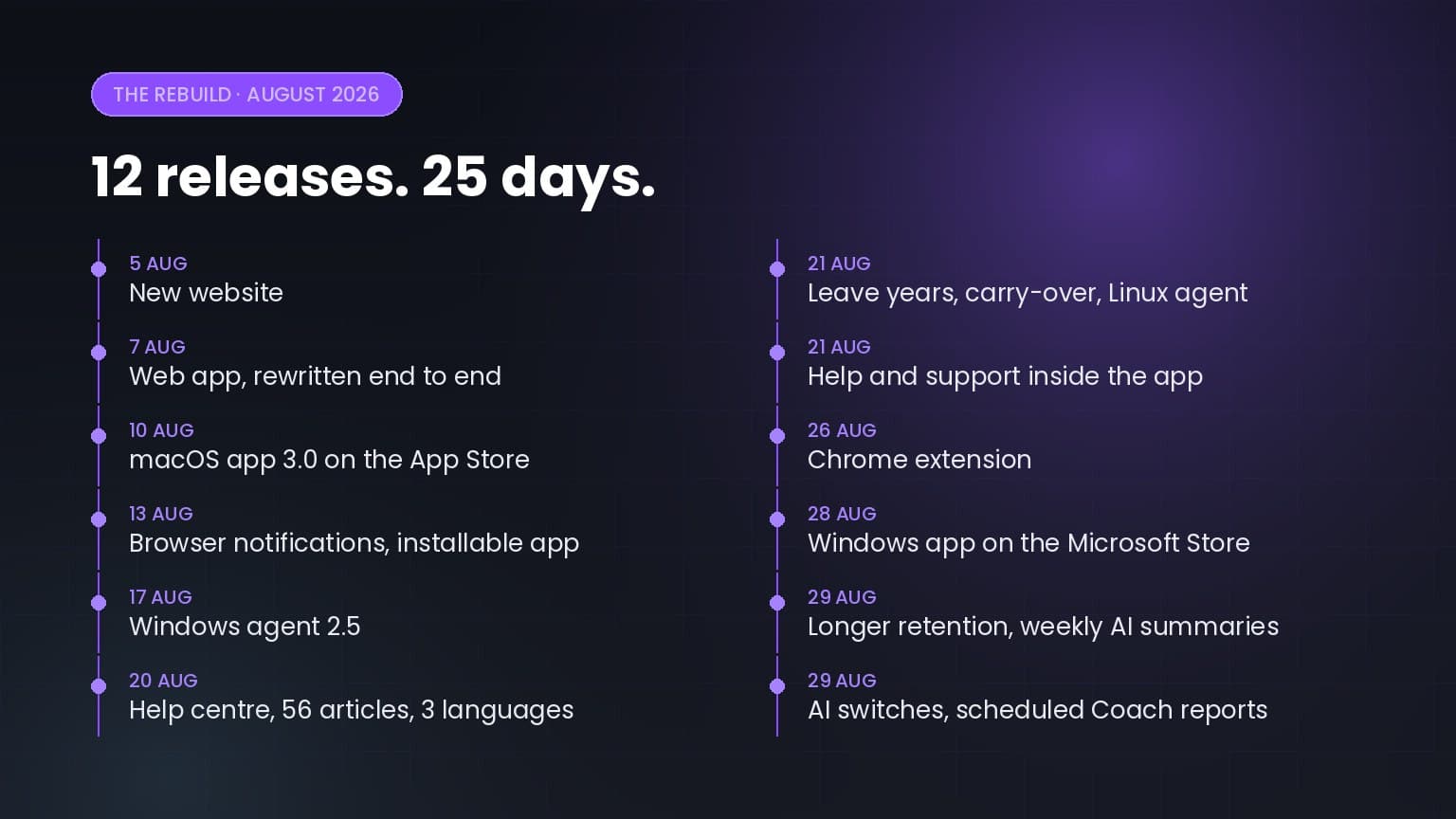
Twelve releases in twenty-five days: a rewritten web app, apps for macOS, Windows, Linux and Chrome, a help centre in three languages, and a…

5+ up-to-date statistics on hybrid and remote work productivity, RTO mandates, employee monitoring, burnout, and where the workday actually goes in…
Worktivity turns the activity your team already generates into a picture you can act on: automatic time tracking, productivity scores and payout-ready reports.
Free 14-day trial. No credit card required.