


News & trends
Ask AI and MCP: your Worktivity data, in plain language
Worktivity now answers questions about your team, projects and time in plain language, and connects to ChatGPT, Claude and any MCP tool.
Worktivity Team10 min read

Billable hours are the units of time a professional spends on client work that can legitimately be invoiced. They typically include client meetings, project work, research, and revisions tied to a specific engagement, but exclude internal admin, training, breaks, and business development. The standard accounting unit is one hour, usually broken into six-minute increments or quarter-hour blocks.
If you run an agency, consultancy, or freelance practice, billable hours are not just an invoicing detail. They are the single most important operational metric in your business. Get them right and the business is healthy. Get them wrong and you lose money on the work you actually deliver, without ever knowing why.
This guide walks through every concrete question a billing-driven business asks about billable hours: what they are, how they differ from non-billable hours, how to calculate them, what good targets look like by role, and the mistakes that quietly drain profit. The final section covers how modern teams capture billable time without forcing anyone to fill in a timesheet.
A billable hour is a unit of work time that meets three conditions:
The third condition is where most disputes happen. A senior consultant flying to a client site can almost always bill travel time. A junior designer attending a portfolio review with the team usually cannot, even though the time is spent on a client deliverable.
The cleanest way to operationalise this: at the start of every engagement, write down what is billable and what is not. One sentence per category. Anyone on the team should be able to look at any block of time and answer "billable or non-billable" without asking.
The grey zone is where the most profit is lost. A junior account manager spends three hours a week handling client emails that aren't really in scope. Over a year of a retainer, that is 156 hours of free work per account. Multiply by ten retainers and the picture gets uncomfortable.
The fix is not to refuse the work. The fix is to measure it accurately, then either include it in the next scope discussion or carve out time to make it billable.
The basic formula:
Billable hours = Time spent on billable activities (over a period)
Utilization rate = Billable hours / Total available work hours
Effective hourly rate = Revenue from the period / Billable hours
Worked example for a 40-hour-per-week consultant over a four-week month:
A few notes on this calculation:
| Role / industry | Typical billable target (annual) | Typical utilization range |
|---|---|---|
| Big law partner | 1,800 to 2,200 hours | 75% to 85% |
| Big law associate | 1,800 to 2,100 hours | 80% to 90% |
| Big-4 consulting (senior) | 1,600 to 1,800 hours | 70% to 80% |
| Management consulting (independent) | 1,200 to 1,600 hours | 60% to 75% |
| Marketing agency (creative) | 1,400 to 1,600 hours | 65% to 75% |
| Marketing agency (strategy) | 1,200 to 1,500 hours | 60% to 70% |
| Software dev agency | 1,500 to 1,700 hours | 70% to 80% |
| Freelance designer | 1,000 to 1,400 hours | 50% to 70% |
| Freelance developer | 1,200 to 1,600 hours | 60% to 75% |
A few honest observations on these targets:
The wrong question is "what should my number be?" The right questions are: "Are we trending up or down quarter to quarter?" and "Are we leaving money on the table that we could capture without working harder?"
By Friday afternoon, most people have already forgotten what they did Monday morning. End-of-week timesheet entry produces data that is incomplete and biased toward big visible blocks. The fix: passive capture, in real time, by the tool not by the person.
The grey zone above is the biggest profit leak. Without explicit rules about what is billable and what is not, account leads default to "if the client asked, it's billable" or "let's not annoy the client". Neither pattern is right. Decide upfront, write it down, share it with the client.
Rounding 47-minute blocks to a full hour, every time, sounds harmless. Over a year on a single account, it can be 100 hours of imaginary work the client didn't receive. Eventually the client notices, in the form of a slightly hostile QBR question. Use real time.
A team can log 80% utilization and still invoice 50%. The gap is scope absorption, write-downs, and forgiveness. If logged hours and billed hours don't reconcile, it is not a billing problem. It is a scope problem.
Pushing utilization above 85% reliably produces burnout, attrition, and quality drift. The mature operational view tracks utilization alongside hours-per-week, weekend activity, deep-work blocks, and burnout-risk signals. We covered this in Workforce Analytics: What It Is, Why It Matters, and How to Get Started.
When the actual hours come in higher than the original estimate, the conversation needs to happen before the invoice, not in it. Real-time time-vs-budget visibility is what makes this possible.
The mature pattern for tracking billable hours in 2026 looks like this:
Capture is passive, not manual. The tool runs in the background, captures application and URL activity, infers project context from the active workspace, and categorises time as billable or non-billable based on rules the team set up once. No timesheet to fill in.
Categorisation is explicit and shared. The rules for what is billable and what is not are written down, shared with the team, and reviewed at the start of every engagement. When the rules change, everyone knows.
Real-time visibility prevents surprises. The account lead can see, on a Monday morning, how many billable hours the team has burned on each client this month, and how that compares to budget. Overruns get caught at week one, not week four.
Utilization sits in a wider operational view. Billable hours, utilization rate, work-pattern health, and burnout-risk signals appear in the same operational view, alongside other metrics. This stops utilization from being optimised at the expense of the team.
Reporting builds itself. The monthly utilization report, the time-vs-budget report, and the per-client profitability view all pull from the same data, with the same definitions. No spreadsheet stitching.
This is exactly the gap Worktivity was built to close. The platform captures time, application activity, and URL category data automatically, categorises billable vs non-billable based on team-defined rules, and surfaces utilization, time-vs-budget, and team-health metrics in one operational view. The team never enters a timesheet. The reporting is ready when you are.
Billable hours are units of work time spent on client deliverables that can legitimately be invoiced under an active engagement. They exclude internal operations like admin, training, new business, and breaks. The standard unit is one hour, usually divided into six-minute or quarter-hour increments.
It depends on the role and the industry. A big-law associate might target 2,000 billable hours per year (roughly 40 billed hours per week, every week). A management consultant might target 1,500. A marketing agency creative might target 1,400. A freelance designer balancing client work with their own sales and admin might target 1,000 to 1,200. The right target is the one that matches your business model and protects your team from burnout.
Add up time logged against client engagements (billable activities) for a defined period. Divide by available work hours in the same period to get utilization rate. Divide revenue invoiced for that period by billable hours to get the effective hourly rate. The cleanest version uses passive time-tracking data, not manual timesheets.
Usually yes, when it is travel directly required for the engagement and the client has agreed to it in the scope. The standard convention is full-rate for client-site time, half-rate for travel time, and no-charge for commute between the consultant's home and their regular base. The convention varies by industry and country, so it should always be written into the engagement letter.
If you are a salaried employee at an agency, consultancy, or law firm: yes. Your compensation covers all of your work time, billable or not. The employer recovers cost through billable utilization at higher rates. If you are a freelancer or independent contractor: only billable hours produce revenue. Your non-billable hours are an investment in the business.
In most professional services contexts, the two terms are used interchangeably. Some firms reserve "chargeable" for time that has actually been written into an invoice, and "billable" for time logged as billable but not yet invoiced. The distinction matters operationally: chargeable hours are revenue, billable hours that didn't make it to the invoice are leakage.
More accurate than people think, especially over long engagements. A 10% rounding error on a 12-month retainer compounds into thousands of dollars of invented or absorbed work. The honest standard is real time, captured automatically, broken into six-minute or quarter-hour increments based on what the client expects to see.
Worktivity captures billable time automatically across every team member, every project, every client. No timesheets, no end-of-month panic. Your utilization and time-vs-budget reports are ready when you are.
Start a 14-day free trial → No credit card required.
More from the same corner of the blog.
Worktivity now answers questions about your team, projects and time in plain language, and connects to ChatGPT, Claude and any MCP tool.
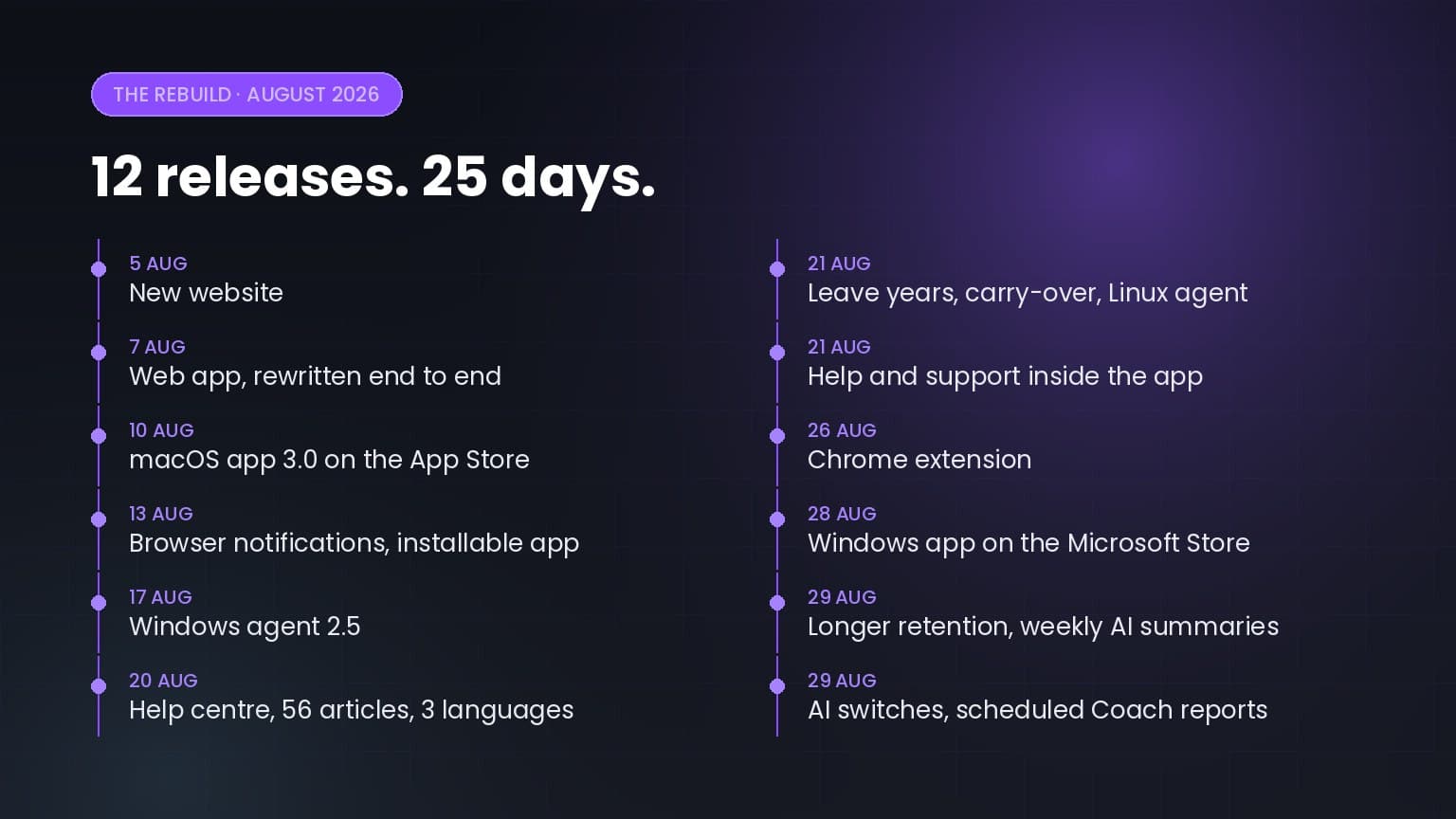
Twelve releases in twenty-five days: a rewritten web app, apps for macOS, Windows, Linux and Chrome, a help centre in three languages, and a…

5+ up-to-date statistics on hybrid and remote work productivity, RTO mandates, employee monitoring, burnout, and where the workday actually goes in…
Worktivity turns the activity your team already generates into a picture you can act on: automatic time tracking, productivity scores and payout-ready reports.
Free 14-day trial. No credit card required.