


News & trends
Ask AI and MCP: your Worktivity data, in plain language
Worktivity now answers questions about your team, projects and time in plain language, and connects to ChatGPT, Claude and any MCP tool.

For many businesses, time is directly tied to revenue.
Companies such as consulting firms, agencies, and law offices often charge clients based on the time spent working on projects.
This is where the concept of billable and non-billable hours becomes important.
Understanding the difference between these two types of work hours helps organizations improve profitability, optimize workflows, and manage resources more effectively.
Billable hours represent time spent working directly on client projects that can be invoiced.
These are hours that generate revenue for the business.
Examples include:
consulting work
design services
software development tasks
legal services
client meetings related to projects
project implementation work
If a company can charge the client for the work, that time is considered billable.
For service-based businesses, billable hours are one of the most important performance metrics.
Non-billable hours refer to work that cannot be billed to clients.
These activities are necessary for business operations but do not directly generate revenue.
Examples include:
internal meetings
training sessions
administrative tasks
internal planning
business development
marketing activities
recruitment and onboarding
Even though non-billable work does not generate revenue, it is still essential for maintaining operations and growth.
| Aspect | Billable Hours | Non-Billable Hours |
|---|---|---|
| Revenue generation | Direct revenue | No direct revenue |
| Client invoicing | Yes | No |
| Example work | Client projects | Internal tasks |
| Business impact | Profitability | Operational support |
Successful businesses aim to maximize billable hours while minimizing unnecessary non-billable work.
Tracking billable hours is critical for organizations that provide services.
Billable hours allow companies to understand how much revenue each employee generates.
Businesses can estimate project costs more accurately based on billable time.
Managers can allocate employees to projects based on workload and availability.
Billable hours are often used to measure productivity in service industries.
Organizations that fail to track billable time accurately often lose significant revenue due to underbilling or inefficient work allocation.
Many businesses struggle with tracking billable time effectively.
Common problems include:
Employees often forget to log time accurately.
Small tasks may go unreported and reduce total billable time.
Tracking time manually can create extra workload for teams.
Managers may not clearly understand how much time is actually billable.
These challenges highlight the importance of automated tracking systems.
Many organizations use time tracking and productivity analytics tools to measure billable work automatically.
These tools record time spent on tasks and generate reports that help managers understand how much time is billable.
Common features include:
automatic time tracking
project time allocation
billable vs non-billable reporting
team productivity analytics
client billing reports
Platforms like Worktivity provide automated productivity and time tracking analytics that simplify billable hour tracking.
This helps organizations improve billing accuracy and optimize workforce productivity.
Organizations can increase billable time through several strategies.
Automate internal processes to reduce non-billable tasks.
Better project planning reduces wasted time.
Analyze how employees spend time during work hours.
Identify inefficiencies that reduce billable productivity.
Companies that actively manage billable time often see significant improvements in revenue and operational efficiency.
Typical billable utilization varies by industry.
Examples include:
| Industry | Typical Billable Rate |
|---|---|
| Consulting | 60–80% |
| Law firms | 70–85% |
| Marketing agencies | 60–75% |
| Software development agencies | 55–70% |
A healthy balance between billable and non-billable work ensures both profitability and sustainable operations.
Billable and non-billable hours are fundamental metrics for service-based businesses.
Understanding how time is allocated across projects and internal tasks allows organizations to:
improve profitability
optimize workforce utilization
enhance project management
increase operational efficiency
Modern productivity analytics platforms like Worktivity help organizations automatically track billable work and generate insights that improve business performance.
More from the same corner of the blog.
Worktivity now answers questions about your team, projects and time in plain language, and connects to ChatGPT, Claude and any MCP tool.
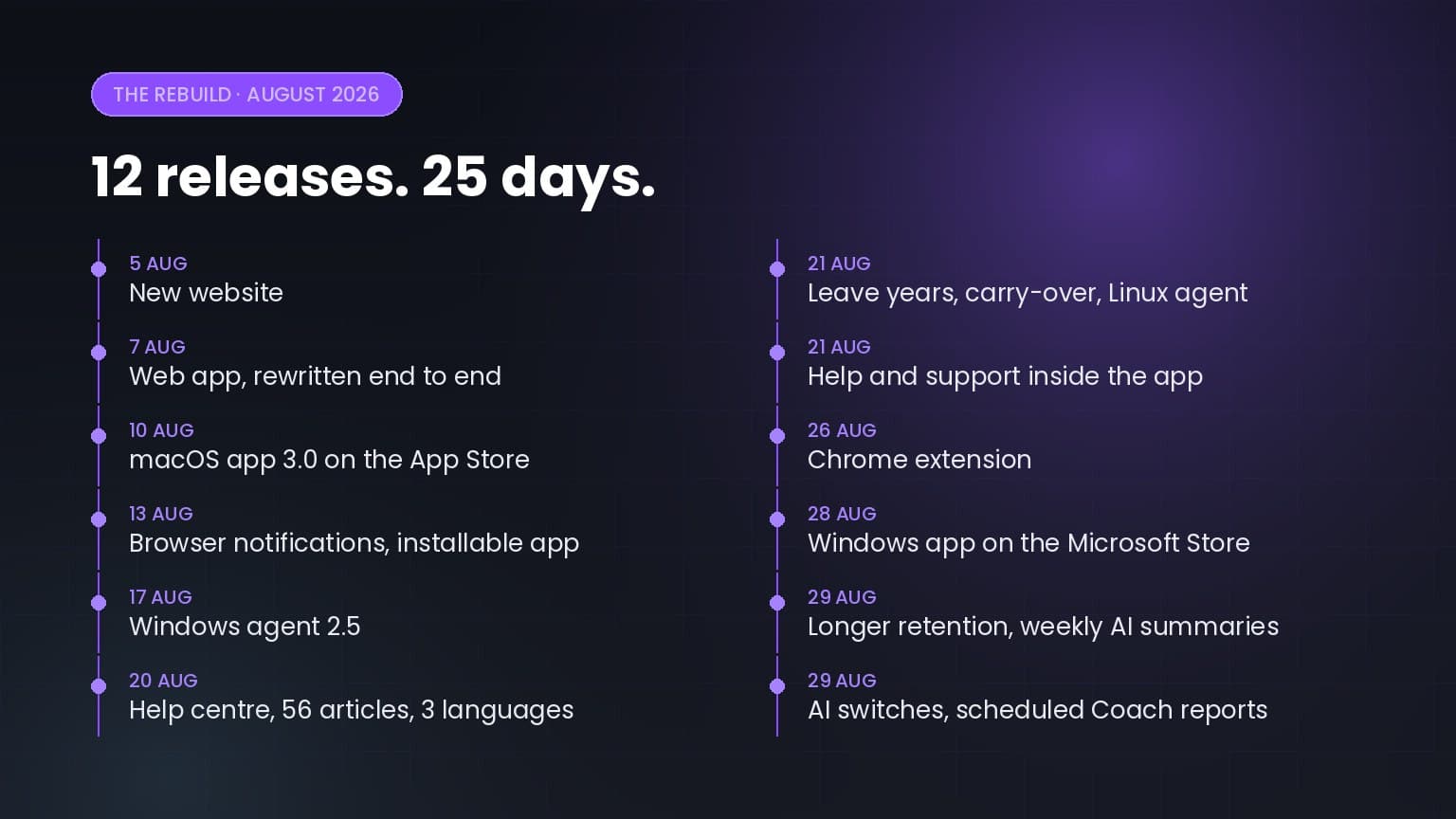
Twelve releases in twenty-five days: a rewritten web app, apps for macOS, Windows, Linux and Chrome, a help centre in three languages, and a…

5+ up-to-date statistics on hybrid and remote work productivity, RTO mandates, employee monitoring, burnout, and where the workday actually goes in…
Worktivity turns the activity your team already generates into a picture you can act on: automatic time tracking, productivity scores and payout-ready reports.
Free 14-day trial. No credit card required.