

News & trends
Ask AI and MCP: your Worktivity data, in plain language
Worktivity now answers questions about your team, projects and time in plain language, and connects to ChatGPT, Claude and any MCP tool.
Worktivity Team7 min read
![Cover image for Productivity Metrics for Developers: What to Track (and What to Avoid) [2026]](/_next/image?url=https%3A%2F%2Fworktivity.b-cdn.net%2Fworktivity-public%2FW%2FUploads%2FBlogPostImage%2Ff5ae2a0d0083448788eda3e4a353741a.png&w=3840&q=75)
Measuring developer productivity is one of the most contentious topics in software engineering. Measure the wrong things and you'll incentivize gaming, destroy morale, and get worse code. Measure nothing and you're flying blind — unable to identify bottlenecks, justify hiring, or improve processes.
The truth sits in the middle: developer productivity can be measured meaningfully, but only if you choose metrics that align with outcomes rather than activity. Lines of code, commit frequency, and hours worked tell you almost nothing about value delivered. Cycle time, deployment frequency, and quality metrics tell you nearly everything.
This guide covers the metrics that actually matter for engineering teams, how to measure them without creating surveillance culture, and the common traps that turn well-intentioned measurement into organizational damage.
Before diving into what to measure, let's be clear about what not to measure — and why.
These metrics share a common flaw: they measure activity, not outcomes. The goal isn't to make developers look busy — it's to understand how effectively the team turns effort into working software that serves users.
The DORA (DevOps Research and Assessment) framework, backed by years of research across thousands of engineering organizations, identifies four key metrics that correlate strongly with both engineering performance and business outcomes:
How often your team deploys code to production. High-performing teams deploy on demand — multiple times per day. This metric reflects the team's ability to deliver value continuously rather than in large, risky batches.
The time from code commit to code running in production. This measures your pipeline efficiency — how quickly a developer's work reaches users. Short lead times mean faster feedback loops and quicker value delivery.
The percentage of deployments that cause failures in production — requiring hotfixes, rollbacks, or patches. This is your quality gate. High deployment frequency means nothing if every third deploy breaks something.
How quickly the team restores service after a production failure. Fast recovery matters more than zero failures — because failures are inevitable. Teams with low MTTR can deploy fearlessly because they can fix issues quickly.
The time from when work begins on a task to when it's complete. Unlike lead time (commit to production), cycle time measures the full development lifecycle. Track it by stage — time in development, time in review, time in QA, time waiting — to identify specific bottlenecks.
How long pull requests wait before receiving their first review. Slow reviews create queues that cascade through the entire development process. High-performing teams review PRs within 4 hours. If your average exceeds 24 hours, it's likely your biggest hidden bottleneck.
Quantitative metrics don't capture everything. Regular developer experience surveys measuring satisfaction, perceived productivity, and tooling friction provide crucial qualitative data. Teams with high DevEx scores consistently outperform on quantitative metrics as well.
The proportion of development time spent on maintenance versus new features. A healthy ratio is 70-80% new feature work and 20-30% maintenance. If maintenance consistently exceeds 30%, technical debt is accumulating faster than you're paying it off.
The fastest way to ruin an engineering culture is to use metrics as individual performance evaluations. Here's how to measure effectively:
First, measure outcomes, not activity. DORA metrics — deployment frequency, lead time, change failure rate, and MTTR — correlate with real business results. Lines of code and hours logged don't.
Second, team metrics over individual metrics. Always. Individual measurement creates perverse incentives and damages collaboration. Team measurement drives systemic improvement.
Third, context matters more than numbers. A team with low deployment frequency might be working on a complex infrastructure migration. A team with high MTTR might have inherited legacy systems. Numbers without context are dangerous.
Fourth, developer experience is a leading indicator. Teams that feel productive, supported, and equipped consistently outperform on hard metrics. Invest in DevEx — it's not a nice-to-have, it's a multiplier.
Understanding how your development team spends their time is the first step toward meaningful improvement. Worktivity provides time allocation analytics, focus time insights, and productivity pattern tracking — giving engineering managers visibility without creating surveillance culture.
Start your free trial at useworktivity.com →
What's the single most important developer productivity metric?
Deployment frequency, if you must choose one. It correlates most strongly with overall engineering performance and business outcomes. But no single metric tells the full story — use DORA metrics together for a comprehensive view.
How do I measure developer productivity without micromanaging?
Focus on team-level metrics, not individual tracking. Use DORA metrics and cycle time measured from your existing tools (GitHub, Jira). Supplement with quarterly DevEx surveys. The goal is systemic improvement, not individual surveillance.
Should we track developer hours?
Time allocation data is useful for understanding where effort goes — but never as a productivity measure. Hours worked says nothing about value delivered. Use time data to identify interruption patterns and protect focus time, not to evaluate individuals.
How often should we review developer metrics?
Review DORA metrics monthly in retrospectives. Review cycle time weekly to catch bottlenecks early. Run DevEx surveys quarterly. Avoid daily metric reviews — they create anxiety and encourage gaming.
More from the same corner of the blog.
Worktivity now answers questions about your team, projects and time in plain language, and connects to ChatGPT, Claude and any MCP tool.
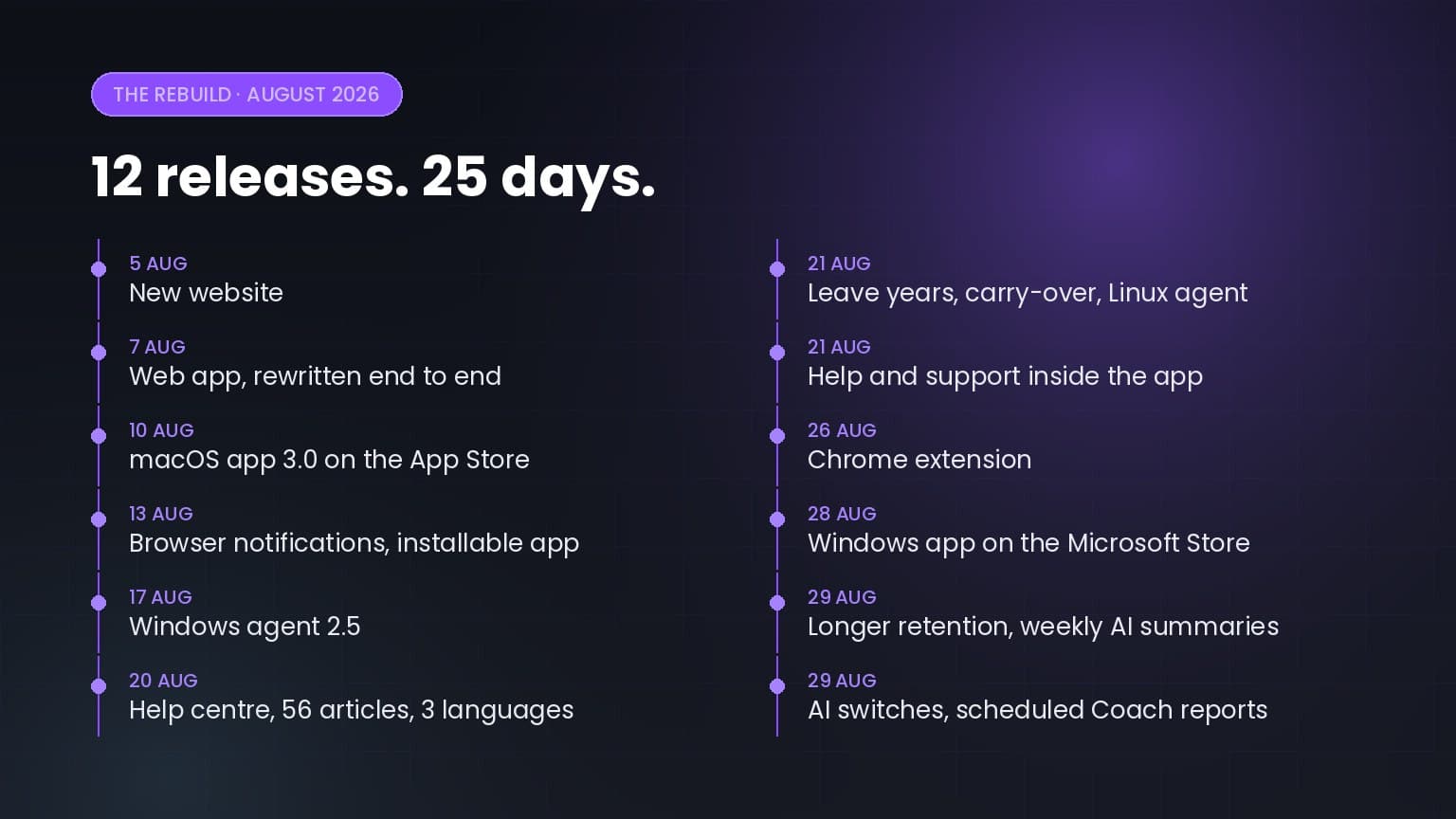
Twelve releases in twenty-five days: a rewritten web app, apps for macOS, Windows, Linux and Chrome, a help centre in three languages, and a…

5+ up-to-date statistics on hybrid and remote work productivity, RTO mandates, employee monitoring, burnout, and where the workday actually goes in…
Worktivity turns the activity your team already generates into a picture you can act on: automatic time tracking, productivity scores and payout-ready reports.
Free 14-day trial. No credit card required.